|
Monday,
January 4, 2010
 Signs
of the Times II
- Happy New Year!! And, New Decade!! Time for some
more signs of the times . . . Click on any photo, below, for a
larger image. Signs
of the Times II
- Happy New Year!! And, New Decade!! Time for some
more signs of the times . . . Click on any photo, below, for a
larger image.
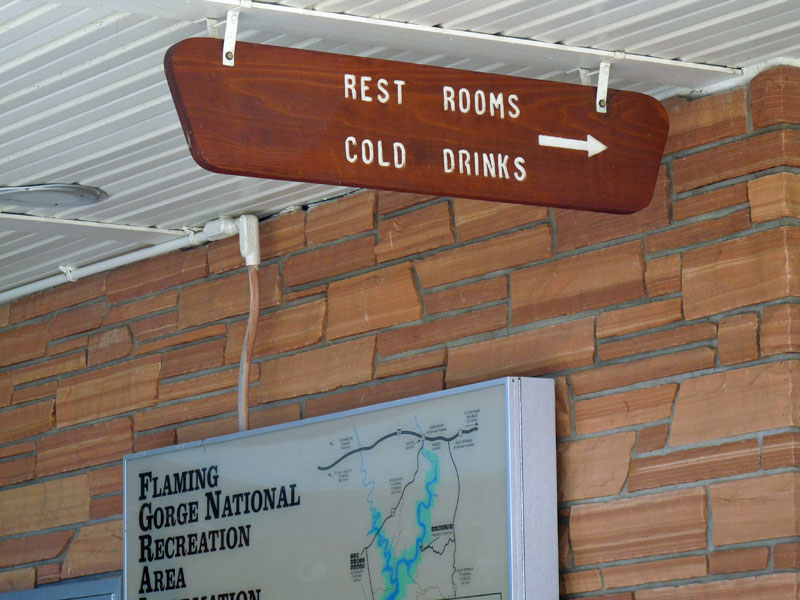
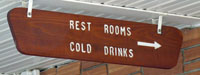 At Flaming Gorge, in
northern Utah, we stopped at the visitor's center. Pretty nice
place, with good camping facilities and nice opportunities for outdoor
activities that
At Flaming Gorge, in
northern Utah, we stopped at the visitor's center. Pretty nice
place, with good camping facilities and nice opportunities for outdoor
activities that
 seem
to have a minimum of government regulation. Still, the sign for
the restroom struck me as odd, especially if you happen to be thirsty! seem
to have a minimum of government regulation. Still, the sign for
the restroom struck me as odd, especially if you happen to be thirsty!
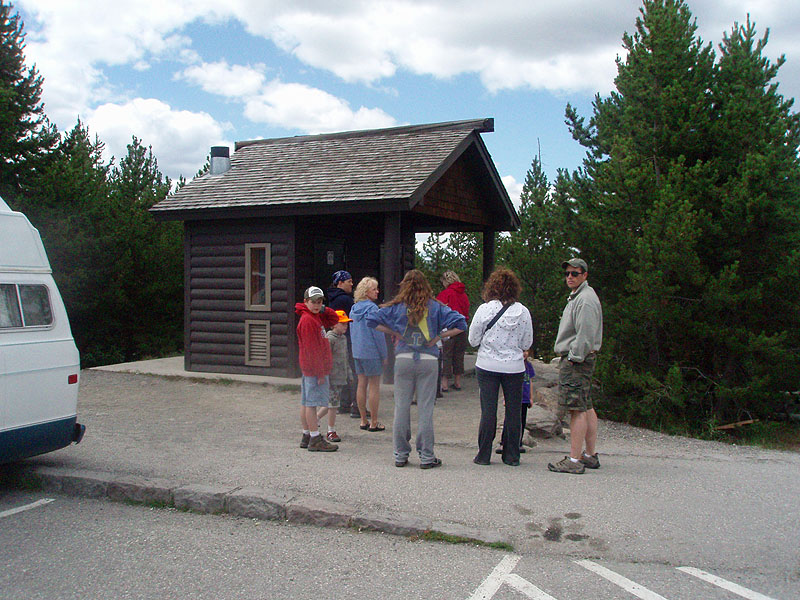
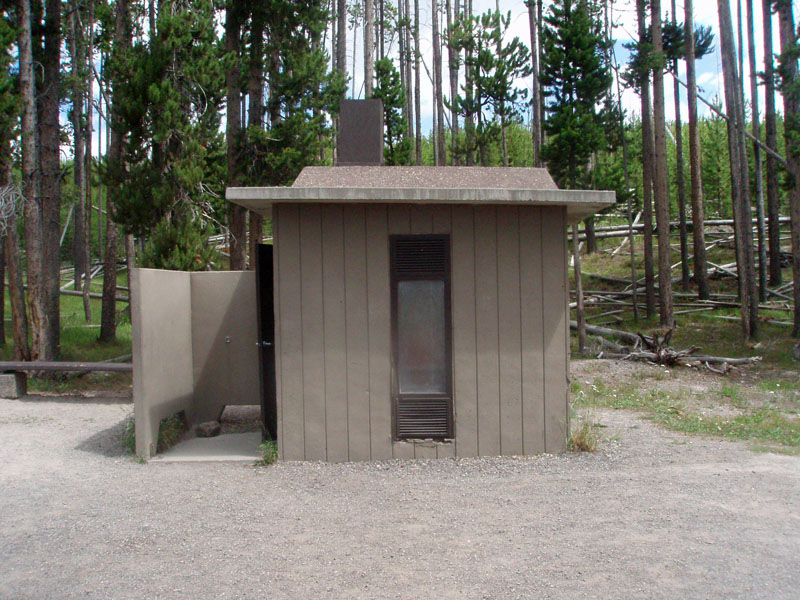
We had stopped at Flaming Gorge on our way to a mini-vacation at
Yellowstone. While there, we toured all the main geyser
areas. Parking was a problem during the height of the day.
And,
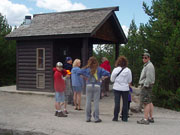
 not surprisingly, there was also quite a bit of congestion at the
public
restrooms. When people line up for a pit toilet, you can pretty
much figure that
there is some problem with management at this national park. not surprisingly, there was also quite a bit of congestion at the
public
restrooms. When people line up for a pit toilet, you can pretty
much figure that
there is some problem with management at this national park.
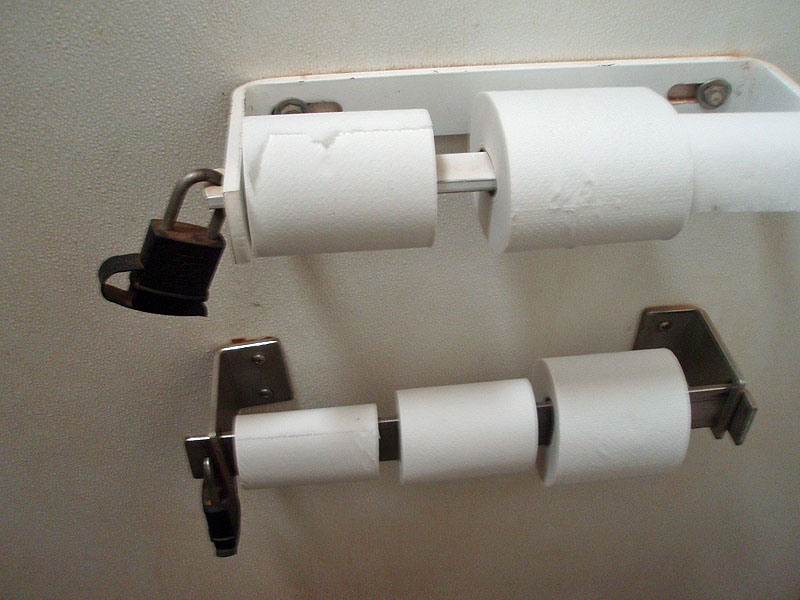
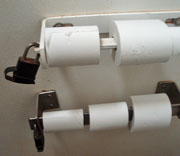
As a frequent visitor to Grand Canyon, I have always chuckled at how
the Park Service puts locks on the toilet paper. Not surprising,
really, since it is a particularly valuable
commodity. It is a great example of Adam Smith's diamond-water
paradox.
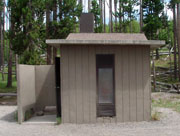
OK, by now you are probably seeing the theme here. This restroom
is located along the main geyser loop that starts from Old
Faithful. We took this walk during our final morning staying at
this location. We both decided that this facility was one of the
worst, if not the absolute worst, outhouse we have ever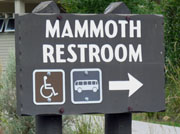 had to
use. It smelled so bad, that we couldn't
even close the door while using it. And, it is within walking
distance of one of America's
foremost natural wonders. Good thing we can't capture the whole essence
on the web!! had to
use. It smelled so bad, that we couldn't
even close the door while using it. And, it is within walking
distance of one of America's
foremost natural wonders. Good thing we can't capture the whole essence
on the web!!
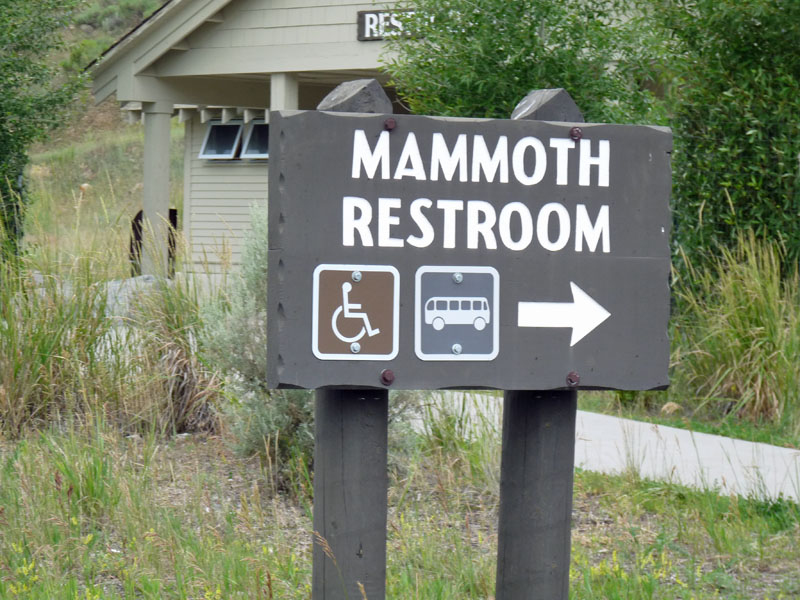
On the other hand, the restrooms at Mammoth Hot Springs
were pretty good, but unlike the inference from the sign shown here,
it wasn't really all that big!!
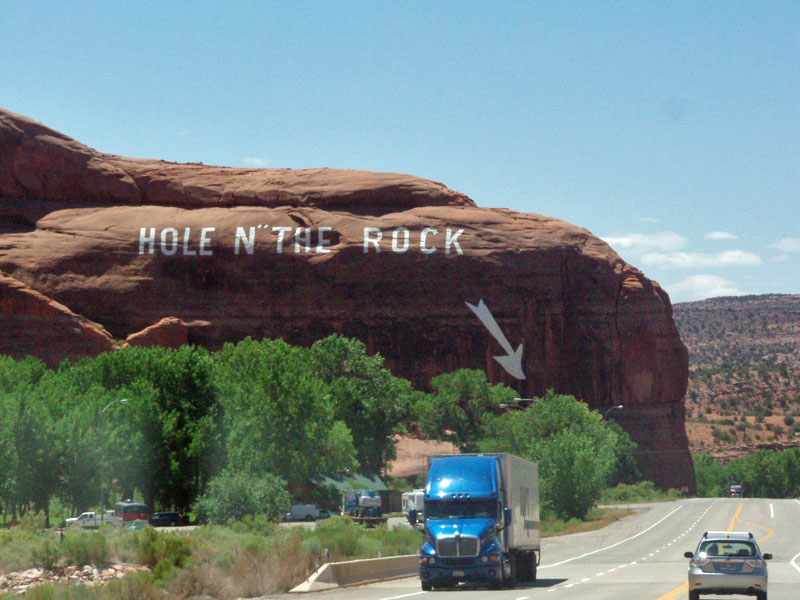
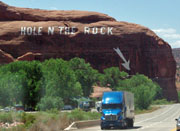 After our trip to Yellowstone, we traveled back home via Utah, staying
for one night at Bear Lake and two nights at Arches National
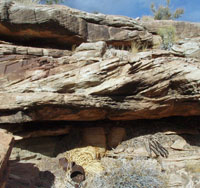
Park. Along the way home from Arches, we passed this place,
which may be a restroom, but we decided it was unwise to check it out!
After our trip to Yellowstone, we traveled back home via Utah, staying
for one night at Bear Lake and two nights at Arches National
Park. Along the way home from Arches, we passed this place,
which may be a restroom, but we decided it was unwise to check it out!
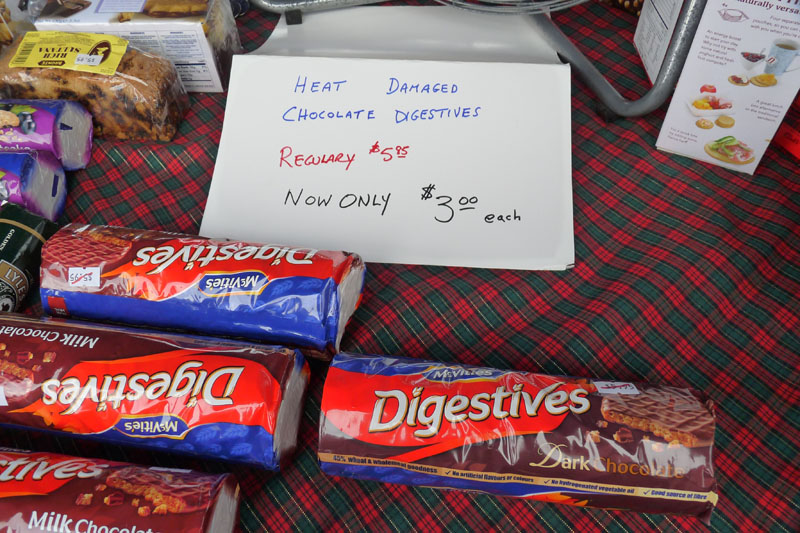
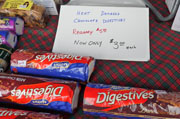 The sign, to the left, was on a table of
British foods offered up at the Celtic Festival in Flagstaff.
You can click on it to see it better, but it reads, "Heat Damaged
Chocolate Digestives. Regularly $5.85. NOW ONLY $3
each." We almost bought some, but would we really have tried
them? Especially if they were heat damaged?? Probably
not, unless we were next to some mammoth restrooms, where the was
lots of TP (because it was locked in place), and we were able to get
a cold drink after doing our business! OK, time to get off my
duff and get some real work done.
The sign, to the left, was on a table of
British foods offered up at the Celtic Festival in Flagstaff.
You can click on it to see it better, but it reads, "Heat Damaged
Chocolate Digestives. Regularly $5.85. NOW ONLY $3
each." We almost bought some, but would we really have tried
them? Especially if they were heat damaged?? Probably
not, unless we were next to some mammoth restrooms, where the was
lots of TP (because it was locked in place), and we were able to get
a cold drink after doing our business! OK, time to get off my
duff and get some real work done.
|
|
Friday,
February 12, 2010
SCOTUS
for Free Speech!
- The Supreme Court struck a blow for free speech with the recent
Citizens
United decision. The case revolved around whether certain McCain-Feingold
restrictions were constitutional. The group, Citizens
United, had put together a political video, but decided that
circulating it would violate the law and took their challenge to the
highest court in the land. To my mind, the whole campaign
finance reform movement has been a farce, at best, and wholly
antithetical to the precepts of the first amendment to the
constitution, at worst. I can vividly recall seeing video footage of Warren
Rudman (Rep) and Eugene
McCarthy (Dem), both retired senators, walking up the steps of the
Supreme Court Building, in contesting these laws. But, I don't
remember the specific circumstance, so I couldn't find a web
link. Still, McCarthy was an early opponent of these laws, and
participated, at some level, in the reasonably well-known Buckley
case.
One might think that liberals would be more inclined to embrace free
speech, but I am coming to the conclusion that the only two
"values" liberals really have are (i) government is good,
and the bigger, the gooder; and (ii) business is bad, and the bigger,
the badder. Still, the ACLU took Citizens United's side in this
case, and the Huffington Post has an unusually cogent and thoughtful
commentary up on its site by the former executive director of the
ACLU.
So, there are issues here that have been debated for some time.
The ruling by the Supreme Court is not especially broad, although
there is talk that McCain-Feingold is headed for the trash heap.
In the local paper, they published a special
commentary on this subject by an academic at NAU's Department
of Criminology and Criminal Justice. Given the venue (the
paper's ad hoc "Coconino Voices" column) and the extended
length, one might expect a polite and civil commentary. Sadly,
that was not the case. Instead of taking the high road, Robert
Schehr launched into a screed against the court, calling for the
impeachment of the justices voting for free speech (i.e., in the
majority). Well, I couldn't resist penning a response, and the
paper published my
letter yesterday. Of course, I don't get as much space as
Schehr did, but I think I got my point across:
|
SCOTUS
and campaign finance (Citizens United)
To the
editor:
The
constitution states that “Congress shall make no law …
abridging the freedom of speech …” How the travesty
known as McCain-Feingold has lasted this long is a puzzle to
me. Its partial dismemberment by the Supreme Court was
like a breath of fresh air.
So, when I
read Robert Schehr’s commentary, I was cringing when he
called for impeaching justices who voted in the majority.
Unbelievable.
Schehr’s
diatribe is false and disingenuous. It is false to
assert that “money is not speech.” Of course it is
speech! If it wasn’t, the only speech we’d get is
from the government. Sort of like Hugo Chavez’
Venezuela, which is not my idea of a role model.
Schehr
infers that we are talking about giant corporations. We
aren’t. The case involved a corporation (non-profit)
that was formed to make and distribute a critical video about
Hillary Clinton. That video could not be shown during
the 2008 primary season because it violated McCain-Feingold.
If they had mass mailed these videos, then the government
would have had to send out the police to round up the
offending “speech” and destroy it. That sends chills
up my spine, even if that doesn’t bother Schehr.
Interestingly,
corporate contributions are permitted for local candidates in
some states. One such state is Illinois. One such
recipient was a state senator named Barack Obama. And,
at least one donor was a foreign corporation. All legal.
And, I have no problem with that. But, I wish that the
Supreme Court had struck down the entire McCain-Feingold
atrocity.
Dennis
Foster
Flagstaff, AZ |
A few other points are
in order here:
 The
Barack Obama story.
The CU web site mentioned this tidbit, but I went web searching to
insure it was accurate before including it in my letter. Indeed,
I sent the letter to the editor (rather than use the on-line
submission) in order to include that support, because I feared that he
would think it was nonsense and we'd have to dance around the issue,
or that he would drop it out of the letter, and I didn't want that to
happen. So, the state of Illinois has a Campaign
Disclosure site, where you can search their database for this
information. I did two searches - one for "Citibank"
and another for "AstraZeneca" (in the "Last or Only
Name" box) and got a list of their contributions. They both
made small ($1000 and $500) donations to the "Friends of Barack Obama," one
in 2001 and the other in 2002. These are exactly the kinds of
corporate donations that have people up in arms. They were, of
course, for his campaign for state office, not his race for the U.S.
Senate - such a donation would be, and still is, illegal.
AstraZeneca is a British-owned firm, although the donations came
through their Delaware offices. So, in his State
of Union address, I don't know if Obama is being disingenuous, or
just plain hypocritical, when he said, "I
don't think American elections should be bankrolled by America's most
powerful interests, or worse, by foreign entities."
The
Barack Obama story.
The CU web site mentioned this tidbit, but I went web searching to
insure it was accurate before including it in my letter. Indeed,
I sent the letter to the editor (rather than use the on-line
submission) in order to include that support, because I feared that he
would think it was nonsense and we'd have to dance around the issue,
or that he would drop it out of the letter, and I didn't want that to
happen. So, the state of Illinois has a Campaign
Disclosure site, where you can search their database for this
information. I did two searches - one for "Citibank"
and another for "AstraZeneca" (in the "Last or Only
Name" box) and got a list of their contributions. They both
made small ($1000 and $500) donations to the "Friends of Barack Obama," one
in 2001 and the other in 2002. These are exactly the kinds of
corporate donations that have people up in arms. They were, of
course, for his campaign for state office, not his race for the U.S.
Senate - such a donation would be, and still is, illegal.
AstraZeneca is a British-owned firm, although the donations came
through their Delaware offices. So, in his State
of Union address, I don't know if Obama is being disingenuous, or
just plain hypocritical, when he said, "I
don't think American elections should be bankrolled by America's most
powerful interests, or worse, by foreign entities."
Money
as free speech.
When I first read Milton Friedman's Capitalism
and Freedom, I was instantly convinced by his argument that
political freedom is an illusion without economic freedom (although
the reverse need not be true). That is, you can't exercise any
political freedom without economic resources. So, if you don't
have access to money, you don't have the ability to operationalize any
political freedom. Powerful stuff. And, quite frankly, in
a country where the political opinion is pretty much 50-50, the
"money" isn't just on one side of the political spectrum.
There
are risks from corporate donations.
Most opponents, Schehr included, make the mistake of thinking that
giant corporations can just pour money into a campaign and win.
Laughable. First, stockholders may react quite unkindly to this
kind of expenditure, and even write restrictions into their own
firm. And, again, in a 50-50 country, can a firm, especially a
giant firm, really afford to potentially alienate half its customer
base? I don't think so. Consider the left wing
opposition to advertisers on Glenn
Beck's most excellent show on Fox News. These advertisers
never endorsed Beck's opinion of anything, and he isn't running for
office, yet they were cowed into pulling ads on one of the most widely
seen shows on cable - which is what advertisers want. So, how
likely is it, really, that they contribute money directly to a
political campaign? Slim and none.
Corporations
need not be large.
The other big issue here, which I mention in the letter, is that the
complaining about "corporate donations" only presumes large
corporations. As I just noted, these firms would be skating on
thin ice to engage in much of that kind of activity (if legal).
More likely, you'd get small groups that have to incorporate in order
to conduct their business. And, they are the ones most likely to
jump into the political fray - e.g., the Swift Boaters of 2004. The
"corporate" designation is legal necessity. But, all
you ever hear about is the scare tactic of the big corporation.
Indeed, here in Flagstaff, one resident has a business selling
t-shirts. A couple years ago, he was selling shirts that said,
"Bush lied. They died." along with the names of fallen
soldiers in Iraq and Afghanistan. Despicable. But, the
state legislature decided it should be illegal. Also, despicable.
And, eventually overturned by a court. The main argument was
that he shouldn't be allowed to profit from his free speech.
Yeech!
Some
large corporations are exempt from McCain-Feingold.
Surprised to learn that "media" corporations don't have to
abide by some of the McCain-Feingold restrictions? Well, not
really, when you consider how politics is done. And, I suspect
that most people would probably agree with the exemption, but it is
still a case of playing favorites - only certain corporations get free
speech rights! Indeed, over the last election cycle, there had
been some talk of prohibiting bloggers from political speech as part
of these ridiculous laws. So far, that hasn't happened.
|
|
Sunday,
February 21, 2010
Ken
Burns' Avatar
- When PBS aired Ken Burns' 12 hour documentary, "The
National Parks," I recorded it for later viewing. This
past week, I have finally gotten around to watching it - pretty much
an episode each night. I am through four episodes and have two
left, but feel compelled to do a bit of blogging about what I have
seen so far.
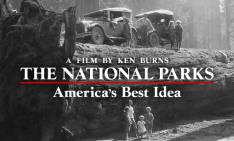 On the one hand, at least this epic isn't all about race, which is the
theme of his earlier works, The
Civil War and Baseball.
I think that race has to be a major theme of the "The Civil
War," but he pushes the agenda a bit far in that documentary. Still, I give him 5 stars for that film and I own a
copy. But, then he goes over the top with this theme in the
later "Baseball" documentary, which led me to get tired of
it and stop watching somewhere along the way. At least in
"The National Parks," the issue of race (primarily with
regard to Native Americans) seems more muted.
On the one hand, at least this epic isn't all about race, which is the
theme of his earlier works, The
Civil War and Baseball.
I think that race has to be a major theme of the "The Civil
War," but he pushes the agenda a bit far in that documentary. Still, I give him 5 stars for that film and I own a
copy. But, then he goes over the top with this theme in the
later "Baseball" documentary, which led me to get tired of
it and stop watching somewhere along the way. At least in
"The National Parks," the issue of race (primarily with
regard to Native Americans) seems more muted.
That got me to thinking about it a bit more. Clearly, we can all
despise the fact of the Civil War, so making it all about race and an
indictment against white Americans works. And, really, baseball
is just a game, so who really cares if that story can also be made all
about racial injustice? But, the parks story presents a
filmmaker like Burns with a dilemma. While he could make this
all about race, too, he is in a bind since he wants to extol the
virtues of the National Parks. Flawed though those virtues
are. So, I am glad that he had to squirm in making this film,
and couldn't play the same race card he usually does.
Still, he does have another card to play - businesses are bad and
greedy and we should hate them. So far, over the course of six
hours, the drumbeat against business has been unremitting. Even
when a business seems to be getting good treatment, there is usually a
twist in the end - for example, the railroads helped to preserve some
places, but it was so they could profit, hence they could not be
trusted. A particularly memorable story involved James
Hutchings, who built a hotel in Yosemite Valley. He was
roundly criticized in the narration, and one early tourist is quoted
as complaining about the cloth dividers which separated the upstairs
rooms. The intent was clearly that Hutchings was trying to scam
tourists by charging a lot and providing little. Yet, in the
next breath, the narration goes on to describe how Hutchings hired
John Muir to build a sawmill and that one of the first things he built
were walls to separate the hotel rooms!
The story of the Grand Canyon is also long on indictment of business,
especially in the form of Ralph
Cameron. Yet, there is no mention that Cameron actually
bought the Bright Angel Trail from the previous proprietor - the
implication is just that he owned the trail by being there. And,
while the Kolb brothers get generally good coverage, not a peep about Mary
Colter, nor the Fred Harvey Company. Indeed, I am quite
astonished at how many spectacular shots of the eastern portion of the
Grand Canyon have been shown without a single sighting of the Desert
View Watchtower!
So, it seems to me that this 12 hour indulgence in anti-business
rhetoric is really just Burns' version of James Cameron's Avatar.
Really cool pictures, but the story drags on far too long, and no 3-D
glasses. I guess that expecting Ken Burns to be "fair and
balanced" was just hoping for too much.
|
|
Saturday,
March 27, 2010
 Common
Sense I
- While
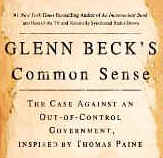
I am technically still in the midst of reading Atlas Shrugged, I have
decided to do a close read of Glenn
Beck's Common Sense. I picked it up last summer and read
through part of it. But, then I set it down and haven't taken
the time to go back and finish up. So, I offered the chance to
discuss the book to the two campus clubs to which I am the faculty
advisor. In preparation of such a discussion, I am reading the
book with pen and paper in hand, so that I can better think about the
issues and themes that Beck raises. So, herewith is the first
part of what I plan to be a five part review of Beck's work as well as
of Thomas Paine's original, which is included in this volume. Common
Sense I
- While
I am technically still in the midst of reading Atlas Shrugged, I have
decided to do a close read of Glenn
Beck's Common Sense. I picked it up last summer and read
through part of it. But, then I set it down and haven't taken
the time to go back and finish up. So, I offered the chance to
discuss the book to the two campus clubs to which I am the faculty
advisor. In preparation of such a discussion, I am reading the
book with pen and paper in hand, so that I can better think about the
issues and themes that Beck raises. So, herewith is the first
part of what I plan to be a five part review of Beck's work as well as
of Thomas Paine's original, which is included in this volume.
Note
& Introduction
Beck
is clearly passionate about his beliefs and unafraid to express what
he thinks. But, he is also unequivocal about this being a
"non-violent" crusade. At regular (or, not) intervals,
he will stop and reiterate that this is not about violence. He
does the same thing on his TV show. His critics may slam his
style, as well as his views, but they never laud his unrelenting
advocacy of peaceful change. So, they aren't serious critics.
His description of who "we" are is
an excellent portrait of the middle class. But, instead of using
that phrase, he paints the picture, so that we can read it and nod
with agreement - yes, that is who we are. He is scathing with
regard to politicians and their lip service to the American
people. He writes that we are not activists, but we are
frustrated. This theme reminded me of Nixon's "silent
majority" - people who stood with his "values" but
weren't about to go out into the streets and march around. I
think there is something to this connection and that Beck is tapping
into the same segment of our society.
I.
The Reshaping & Redefining of America
Beck is keen to write about our discomfort at
the way things are. But, it all seems rather vague and
general. I suppose that reflects our current situation. On
the one hand, we hate politicians, yet, on the other hand, we keep
voting them back into office. His argument that we are
inevitably drawn to a "life of ease," thus sacrificing our
freedoms and liberties captures the difficulty in getting people
interested in the discussion to begin with. We may empathize
with Peter Finch's character in Network
when he sticks his head out the window and cries out, "I'm mad as
hell and I'm not going to take it any more." But, then
what?
I think Beck is right when he notes that most
Americans don't really know what they believe. Partly, this is
due to just taking our situation for granted. But, also, I think
it is the inherent difficulty in getting people to sit down and say to
themselves, "You know, I like the idea of self-rule and
freedom." It seems like it was easier to do this during the
Revolutionary War, and the Civil War and WWII, but that it is quite
difficult for people to hang their hats on those ideas when not faced
with such overt calamities.
Well, and that tells us what Beck is railing
about - covert calamities. Ones that are hard to define
precisely. Ones that almost inevitably get boiled down into
dueling catch phrases ("Kill the Bill" vs. "Health Care
for All"). I agree wholeheartedly with Beck's observation
that government is an "unreliable ... partner in safeguarding ...
liberty." But, then people want prescription drug coverage,
and they want to use public transit, and they like the idea that poor
and disadvantaged people get taxpayer help. In a contest between
principles and specifics, it is very hard for principles to win out.
II.
Money - The Real Opiate of the Masses
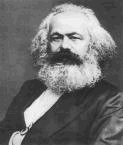 I don't know if most readers get the reference to the subtitle here - Karl
Marx (but, on the topic of religion). I don't think that
"money" is the right term here, but it is an easy target for
Beck. His discussion about the trillions of dollars of unfunded
liabilities (Medicare, Social Security, et al.) is spot on. The
problem is that everyone wants a free lunch, and, as any economist
will tell you, there
ain't no such thing as a free lunch. Beck's relating this to
Ponzi schemes in general, and Bernie Madoff in particular, fits in
with my take on the true problem. And, while Beck argues that
this is a current dilemma, I would respectfully disagree. Of
course, Charles
Ponzi was from an earlier era. And, when we talk about the
housing bubble, certainly many of us will call to mind the famous tulip
bubble that infected the Dutch in the 1600s.
I don't know if most readers get the reference to the subtitle here - Karl
Marx (but, on the topic of religion). I don't think that
"money" is the right term here, but it is an easy target for
Beck. His discussion about the trillions of dollars of unfunded
liabilities (Medicare, Social Security, et al.) is spot on. The
problem is that everyone wants a free lunch, and, as any economist
will tell you, there
ain't no such thing as a free lunch. Beck's relating this to
Ponzi schemes in general, and Bernie Madoff in particular, fits in
with my take on the true problem. And, while Beck argues that
this is a current dilemma, I would respectfully disagree. Of
course, Charles
Ponzi was from an earlier era. And, when we talk about the
housing bubble, certainly many of us will call to mind the famous tulip
bubble that infected the Dutch in the 1600s.
 So, I am not convinced that politicians are any better than they were
in the past. The harkening back to the good old days, when
character mattered, is . . . well, disingenuous. A book I
have my students read is Thomas DiLorenzo's How
Capitalism Saved America. I was fascinated by DiLorenzo's
cataloging of political abuses in the early days of the Republic, when
many states (and, later, the Confederate States of America) actually
wrote into their constitutions prohibitions on the use of tax money
for road improvements. These were early examples of unfunded
liabilities, or debt gone bad, which almost bankrupted many states.
So, I am not convinced that politicians are any better than they were
in the past. The harkening back to the good old days, when
character mattered, is . . . well, disingenuous. A book I
have my students read is Thomas DiLorenzo's How
Capitalism Saved America. I was fascinated by DiLorenzo's
cataloging of political abuses in the early days of the Republic, when
many states (and, later, the Confederate States of America) actually
wrote into their constitutions prohibitions on the use of tax money
for road improvements. These were early examples of unfunded
liabilities, or debt gone bad, which almost bankrupted many states.
When it comes to debt issues, I agree with
Beck that it is out of control. But, debt, in and of itself, is
not bad. And, the relative level of debt we have had was much
higher following WWII. So, I would argue that there is more
nuance here than Beck is willing to consider. And, when it comes
to our "dependence" on foreigners when we sell our debt, I
take a different view. If the Chinese decide they don't want to
buy our debt, it will hurt them as well as us. But, to the
extent that it makes it harder for us to sell debt, raising interest
rates in the process, so it helps galvanize us to oppose this debt.
|